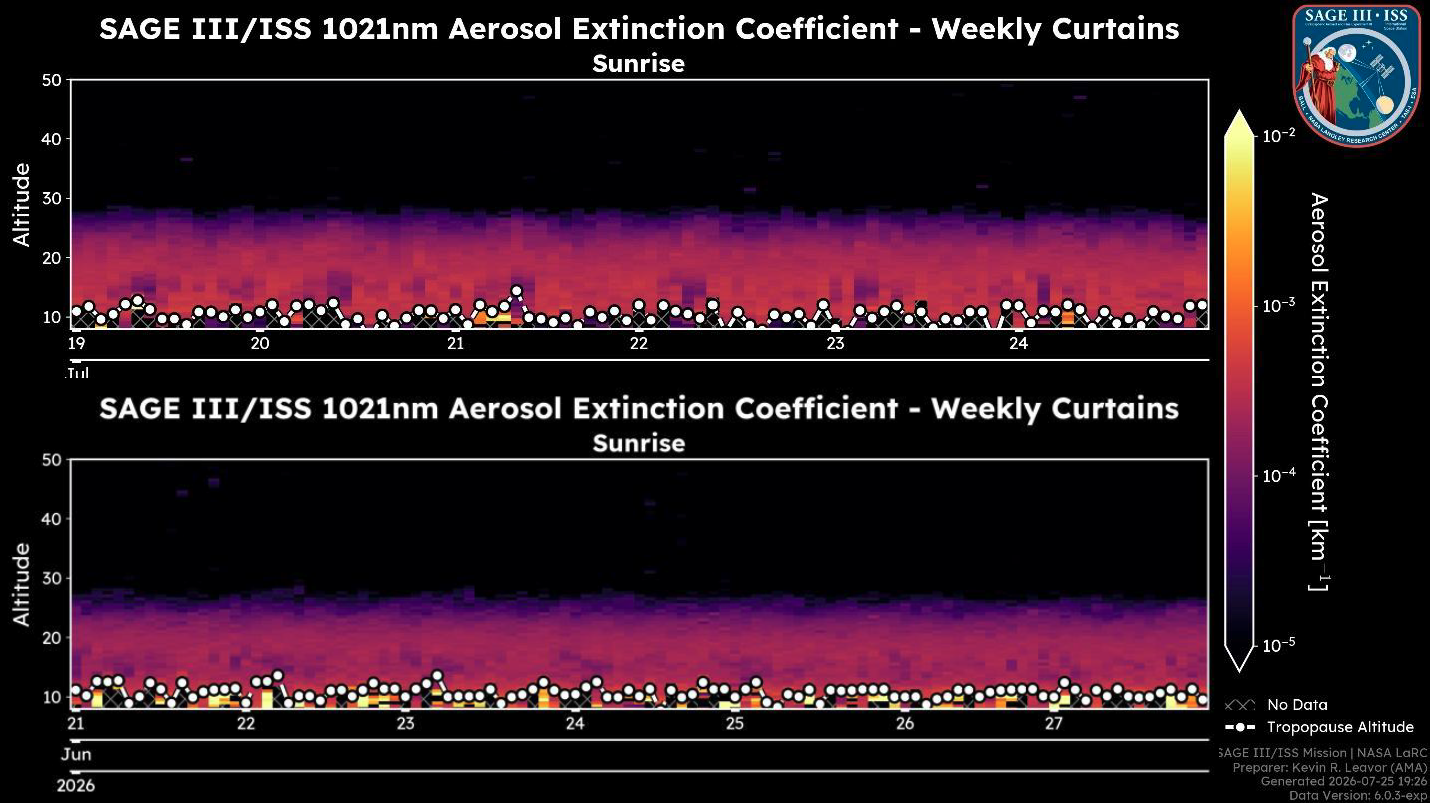
Summertime in the northern mid-latitudes all too often means large scale wildfires, and 2026 is no exception to that cycle with huge fires burning in Canada and the western US since early-July and recently in western Europe. Smoke from the wildfires in Canada was transported 1000s of miles exclusively in the troposphere to the US Eastern seaboard and Southeast. The mechanisms of injecting smoke into the stratosphere from extreme fires like these and subsequently transporting over the hemisphere are possible but not fully understood. The new Earth Venture Sub-orbital mission INjected Smoke and PYRocumulonimbus Experiment (INSPYRE) will test the hypothesis that: Increasing wildfire size and intensity will amplify pyroCb-driven smoke injection into the stratosphere and induce measurable changes to Earth’s radiative balance. Changes to the radiative balance are primarily through enhancing the stratospheric aerosol amount and optical characteristics. SAGE III/ISS is supporting INSPYRE with observations that help define the baseline stratospheric aerosol loading and spectral dependance of the optical extinction of light at the beginning of the 2026 Northern Hemisphere Summer. Examples are shown in the first figure below for the last week of July 2026 and June 2026 at latitudes between 45N and 60N.
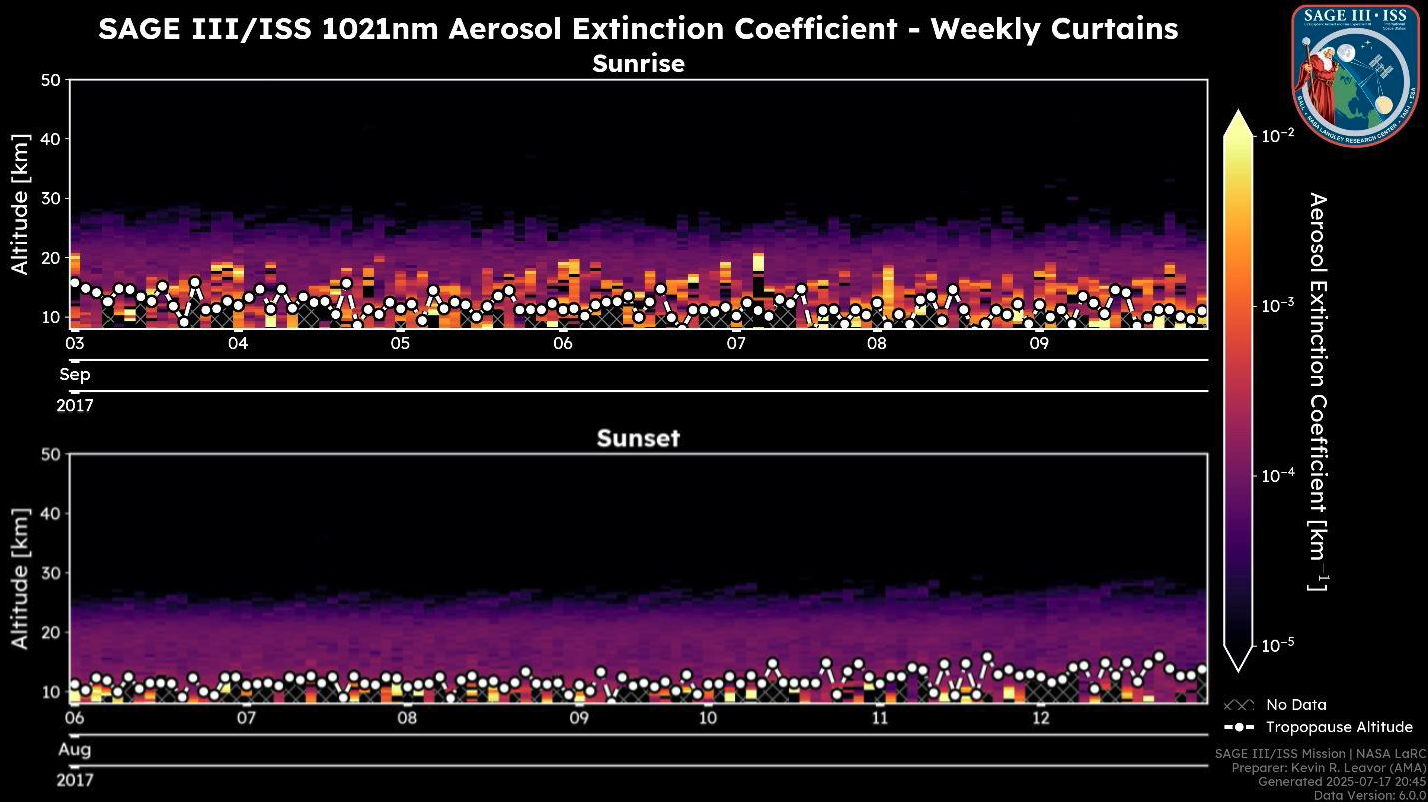
How abruptly the aerosol loading can change from wildfires was witnessed earlier in the SAGE III/ISS mission when extreme fires in the Pacific Northwest enhanced the aerosol content several orders of magnitude in the late summer of 2017. At the time, it was a record setting event for smoke injection. In the second figure, the bottom panel (Aug. 6-12, 2017) shows the situation before the fires and after in the top panel (Sep. 3-9, 2017).